

School of Banking, Finance & Investment
MBA in Banking Management
Strategy, risk and regulation for leaders in commercial, retail and central banking.

Overview
About this specialisation
A specialised postgraduate program for strategic leaders and financial experts in a fast-moving global banking sector. It combines academic frameworks with industry practice across corporate finance, international banking operations, risk assessment, financial compliance and strategic management.
Built for working professionals, mid-level managers and aspiring financial executives, the program sharpens decision-making, digital innovation in banking and the leadership needed to handle market volatility, modern regulation and financial technology.
What you will gain
- Run credit, market, operational and liquidity risk with confidence, including stress testing.
- Understand treasury and asset–liability management: LCR, NSFR, yield curves and balance-sheet optimisation.
- Apply Basel III / IV, AML, KYC and sanctions requirements to day-to-day banking.
- Evaluate fintech, open banking and AI applications in credit scoring and fraud detection.
Curriculum
What you will study
Year 1 · Part AStrategic management & financial foundations
- 01Strategic Management & LeadershipBusiness strategy formulation and execution; strategic decision-making and organisational transformation.
- 02Financial Management & AccountingCorporate financial statement and cash-flow analysis; capital structure, valuation models and the cost of capital.
- 03Macroeconomics & Financial MarketsMonetary policy, interest rates and global financial dynamics; FX, money and capital markets.
Year 1 · Part BCore banking operations & risk
- 01Commercial & Retail Banking OperationsCore banking architecture, credit assessment and loan portfolio management; retail products and the customer lifecycle.
- 02Bank Financial Risk ManagementCredit, market, operational and liquidity risk; stress testing and mitigation strategies.
- 03Human Resource & Organisational DynamicsTalent and leadership in financial institutions; organisational behaviour, culture and ethics.
Year 2 · Part AAdvanced banking & regulation
- 01Banking Treasury & Asset–Liability ManagementInterest-rate risk, balance-sheet optimisation and yield curves; LCR and NSFR.
- 02Fintech, Digital Banking & InnovationOpen-banking APIs and distributed ledgers; AI and machine learning in credit scoring and fraud detection.
- 03Banking Law, Compliance & Global GovernanceBasel III / Basel IV frameworks; AML, KYC and global financial sanctions.
Year 2 · Part BResearch methodology & applied dissertation
- 01Business Research MethodsQuantitative and qualitative methods; data analytics and statistical tools for empirical research.
- 02Applied Master’s ThesisA supervised, independent project on a live banking challenge such as credit-risk modelling, digital adoption or a compliance framework.
Careers
Where it can take you
Graduates of this specialisation typically move towards roles such as:
Assessment
How you are assessed
Most modules are assessed through practical case studies. You choose one of three examination modes:
- Open-book case study. Case assignments are sent to you under confidential cover and returned within 12 days.
- Email examination. The paper arrives by email; you answer in your own handwriting and courier the originals within 12 days.
- Centre examination. A three-hour paper with subjective and objective questions, at an authorised centre where numbers allow.
| Score | Grade |
|---|---|
| 75% and above | A+ |
| 65% – 74.49% | A |
| 55% – 64.49% | B |
| 50% – 54.49% | C |
Fees
Tuition and payment plans
| Route | Payment plan | Total |
|---|---|---|
| Regular · 2 years | Year 1: $1,200 Year 2: $1,200 | $2,400 |
| Fast track · 1 year | First half: $1,200 Second half: $1,200 | $2,400 |
Each payment can be split into instalments (charges apply), which brings the regular route to about $100 a month. Fees are paid by online transfer and are subject to revision.
Entry requirements
Who can apply
- A bachelor’s degree (graduate) or a postgraduate degree.
- At least three years of professional work experience, supported by an experience letter.
- A passport valid for at least six months.
- A completed registration form, CV and passport-size photographs.
School of Banking, Finance & Investment
Related specialisations
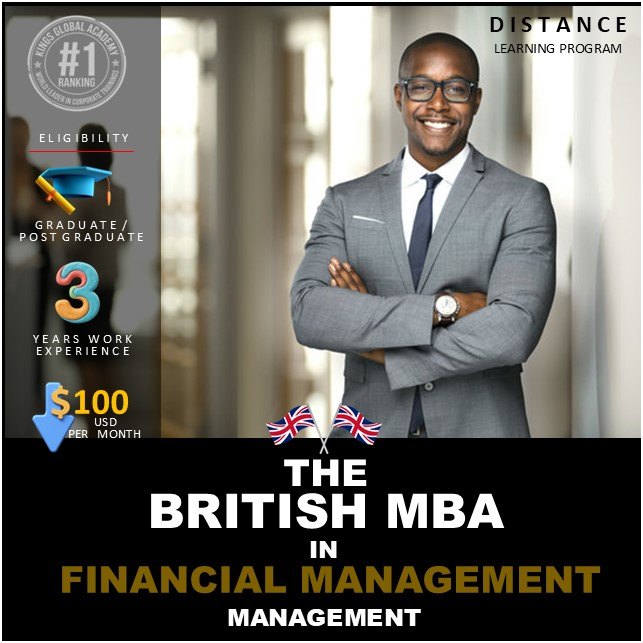
Financial Management
Corporate finance, valuation and treasury for the route to CFO.

Investment Management
Portfolio construction, asset allocation and fiduciary leadership.
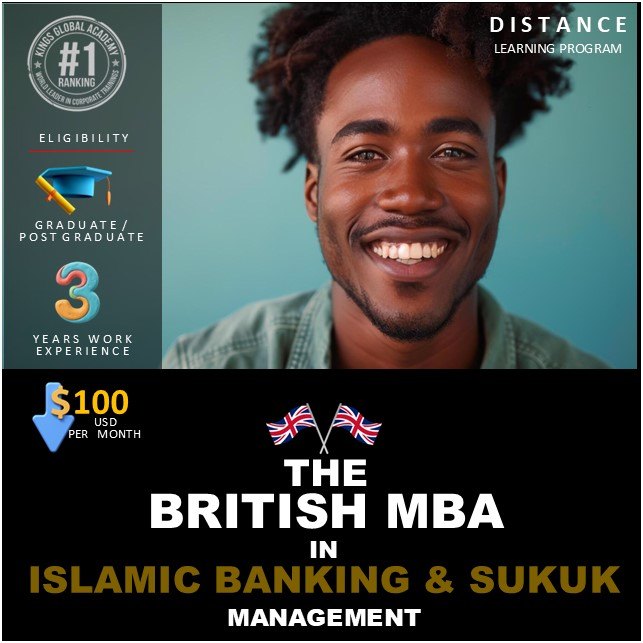
Islamic Banking & Sukuk
Shariah-compliant banking products, sukuk structuring and Islamic capital markets.

Admissions 2026–27
Ready to start your MBA in Banking Management?
Speak to an advisor today. We will check your eligibility, explain the payment plan and reserve your place for the next start date.